The short answer
Cutting to the chase: The span is that wide because the phrase covers a magnetic gadget and a whole-house reverse osmosis system in the same breath. Sizing is arithmetic rather than guesswork: hardness in grains per gallon multiplied by daily household gallons gives grains removed per day, and the unit is chosen so regeneration happens every few days rather than every night.
The short version: Published water softener cost ranges, how grain capacity is worked out from hardness and household demand, and an honest look at when softening is not worth buying.
What a softener does, mechanically
An ion exchange softener is a tank of resin beads carrying loosely held sodium ions. Calcium and magnesium, the minerals that make water hard, bind to that resin more strongly than sodium does, so as water passes through they swap places with sodium and stay behind on the beads.
Eventually every bead is loaded and the tank stops working. Regeneration is the fix: brine made from the salt in the second tank is drawn through the resin, the concentration reverses the exchange, and the hardness minerals wash to drain. Two consequences follow, and they explain the running cost. A softener consumes salt, and it consumes water, because regeneration is a rinse.
What a softener does not do matters as much. It is not a filter: it removes neither sediment, chlorine taste, lead, nitrate nor bacteria. Buying one to fix a taste complaint is the most common wasted purchase in this category.
What published cost data says
Published ranges are useful for one thing: deciding whether a number handed to you sits inside the normal band. They are not estimates for a specific house.
That separation is the most useful line in the dataset, because it shows how much of the total is plumbing rather than appliance.
| Item | National (Angi) | Denver (Angi) |
|---|---|---|
| Average installed cost | about $1,500 | $1,587 |
| Typical spend range | $150–$11,000 | $212–$6,348 |
| Unit only, excluding installation | not stated | $200–$3,500 |
| Single-tank ion exchange | $500–$1,700 | $570–$1,700 |
| Double-tank ion exchange | $1,000–$5,000 | $1,700–$6,500 |
| Salt-free conditioner | $800–$4,000 | $600–$4,200 |
| Magnetic device | $200–$600 | $350–$750 |
| Reverse osmosis, point of use | $1,500–$1,800 | $450–$2,000 |
| Reverse osmosis, whole home | $4,000–$11,000 | $800–$6,500 and above |
| Installation labor | $150–$1,000 | $45–$200 per hour, or $170–$425 per worker for a basic install |
| Softener repair | $150–$900, up to $2,000 | not stated |
| Rental | $25–$50 per month | not stated |
The word covers four different products
Most confusion about price comes from comparing things that do different jobs. Only one category below actually removes hardness, and it is the one needing salt and a drain.
There is a published benchmark behind that distinction. The Water Quality Association notes that NSF/ANSI standards 44 and 330 define soft water as containing less than one grain of hardness per gallon, under 17.1 mg/L. A device that leaves the calcium and magnesium in the water cannot meet that definition, whatever else it may usefully do.
- Ion exchange, single tank. The default. Removes hardness, needs salt, a drain and a power outlet. Goes offline briefly during regeneration, usually overnight.
- Ion exchange, twin tank. Two resin tanks alternate so soft water is available continuously. Angi's national range runs $1,000 to $5,000 against $500 to $1,700 for single tank, and the extra buys continuity rather than better water.
- Salt-free conditioners, usually template-assisted crystallization. They change how the minerals behave so they are less likely to stick as scale, but hardness stays in the water and a test still reads hard. Reasonable where brine discharge is restricted.
- Magnetic and electronic descalers, at Angi's $200 to $600. The least expensive line on the table and the hardest to verify. Ask for a hardness measurement before and after.
Sizing is arithmetic, and it needs two numbers
Hardness comes from the utility's annual water quality report or from a test, and it needs to be in grains per gallon. Utilities usually publish mg/L as calcium carbonate; divide by 17.1 to convert, the factor implied by the NSF/ANSI soft-water definition above.
Daily use is where people overestimate. EPA WaterSense states the average American family uses more than 300 gallons per day at home and that roughly 70 percent of that occurs indoors, putting indoor use near 210 gallons. Indoor use is the number that matters, because irrigation is normally bypassed. WaterSense also notes the arid West has some of the highest per capita residential use precisely because of landscape irrigation, so a Arizona meter reading overstates what needs softening.
Multiply grains per gallon by indoor gallons per day for the daily hardness load. Then choose a unit that regenerates every few days rather than nightly, because every regeneration spends salt and water. A unit regenerating daily is undersized regardless of what the box says.
- Get a hardness figure in mg/L from the utility's annual water quality report, or test directly if the supply is a well.
- Convert to grains per gallon by dividing mg/L by 17.1.
- Estimate indoor use rather than total metered use, excluding irrigation and any hose bibb that will be bypassed.
- Multiply grains per gallon by indoor gallons per day to get the daily hardness load.
- Choose a rated capacity covering several days of that load, then ask what salt setting and regeneration interval the proposal assumes.
- Ask about iron specifically. It loads the resin too and is often better handled by separate equipment, so it should be named rather than absorbed into a hardness figure.
How the numbers land in practice
The table runs that arithmetic against the EPA WaterSense indoor figure of roughly 210 gallons a day across a range of hardness levels. It is a worked illustration, not a specification.
One caveat matters. Printed grain ratings are achieved at maximum salt dose, and running a unit that way is inefficient. Real capacity at an economical setting is materially lower, so read the columns below as an upper bound.
| Hardness | Grains per day | 24,000-grain unit | 32,000-grain unit | 48,000-grain unit |
|---|---|---|---|---|
| 5 gpg (about 86 mg/L) | 1,050 | about 23 days | about 30 days | about 46 days |
| 10 gpg (about 171 mg/L) | 2,100 | about 11 days | about 15 days | about 23 days |
| 15 gpg (about 257 mg/L) | 3,150 | about 8 days | about 10 days | about 15 days |
| 20 gpg (about 342 mg/L) | 4,200 | about 6 days | about 8 days | about 11 days |
| 25 gpg (about 428 mg/L) | 5,250 | about 5 days | about 6 days | about 9 days |
What goes wrong at each end of the size range
Sizing errors do not announce themselves. An undersized unit produces hard water intermittently, which reads as a fault. An oversized unit produces soft water and quietly costs money every month. The symptoms point at completely different fixes, so they are worth separating.
- Undersized: hardness breaks through late in the day or during heavy use, so scale keeps forming and the owner concludes the softener is broken.
- Either way, a control valve set on a fixed timer rather than metered demand wastes salt on holiday weeks and runs short during busy ones. Ask for metered regeneration by name.
- Bypass valves matter as much as size. Irrigation, exterior hose bibbs and often a drinking water tap should sit outside the softened loop.
What drives the installation half of the price
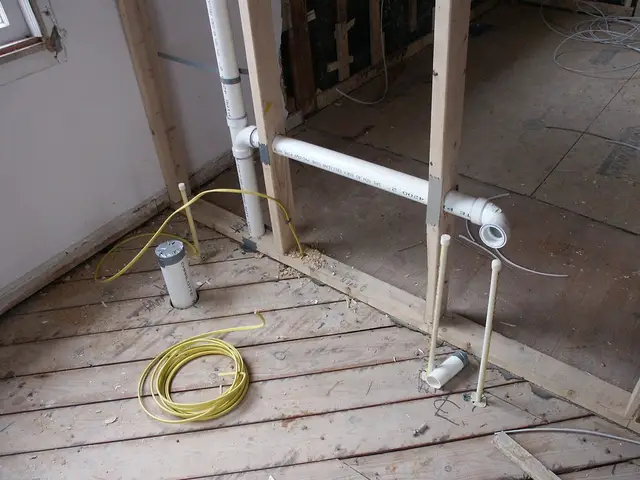
That range is not about the plumber. It is about what the house already has in place: a softener loop, a floor drain and an outlet make a short job, while a finished utility room with none of those makes it a project.
- Position relative to the water heater. The softener goes downstream of the meter and upstream of the heater; retrofitting that order into existing pipework is where hours go.
- A drain within reach, with a proper air gap. Brine discharge cannot be hard-piped into a drain without protection against backflow.
- Bypass plumbing for irrigation and exterior taps: extra pipe and fittings now, years of salt saved later.
- Well systems add a pressure tank and sometimes iron or sediment pre-treatment ahead of the softener, on separate line items.
The costs that continue after installation
A softener is one of the few plumbing purchases with a real monthly consumable. Angi's 2026 figures put softener salt at $5 to $10 for a 40-pound bag, and potassium chloride, the substitute used where sodium is a concern, at $50 to $70 for the same weight. That is a large multiple for the same job.
Water use is the cost nobody quotes. Every regeneration rinses the bed and sends brine to drain, which shows up on the water bill rather than any invoice. Angi puts softener repair at $150 to $900 on average and up to $2,000, with control valves and resin beds the usual culprits, and lists rental at $25 to $50 per month, which suits a short tenure and is poor value over a decade.
- Water consumed by regeneration, invisible until one year's bill is compared with the last.
- Chloride discharge to the sanitary sewer, which some jurisdictions regulate. Confirm the local wastewater rules for the address before buying, because this is set locally rather than statewide.
When a softener is not worth buying
A large share of households considering one do not need it, and the deciding factor is a measured hardness number rather than a symptom.
- Hardness measures at the low end. Under the USGS classification 0 to 60 mg/L is soft and 61 to 120 mg/L moderately hard, and the case weakens fast in that territory.
- The complaint is taste, odor or discoloration. Those are filtration questions; a softener addresses none of them.
- Someone is on a sodium-restricted diet and no drinking water bypass is planned. Potassium chloride solves it at Angi's $50 to $70 per 40-pound bag against $5 to $10 for salt, which changes the running cost substantially.
- The local wastewater authority restricts brine discharge. Confirm before ordering, not after.
- Only the appliances matter. Descaling the water heater and cleaning aerators on a schedule is a legitimate alternative at a fraction of the cost.
Where DIY ends and the license begins
- The supply is a private well and iron, manganese or a sulfur odor is present. Resin fouls quickly on those, and the treatment train needs designing rather than assembling.
- Anyone in the household is on a medically restricted sodium intake and the drinking water tap has not been bypassed.
- Soft water appears at some taps and hard water at others. That usually means the plumbing was tied in incorrectly rather than that the unit failed.
- The brine tank is holding standing water above the salt, or a salt bridge has formed and the unit has been running without regenerating.
- Brine discharge has been hard-piped into a drain with no air gap. That is a cross-connection question and a code question.
How Arizona handles this
Plumbing in Arizona is regulated by Arizona Registrar of Contractors (ROC). Contractor licensing in Arizona is state-level through the Arizona Registrar of Contractors, but building and plumbing code adoption and permitting are entirely local because Arizona has no mandatory statewide building code. Permitting is entirely local in Arizona. Many jurisdictions in the Maricopa County area accept residential equipment replacement permits through a shared online portal, and Pima County publishes a dedicated permit page for air-conditioning and water heater replacements - a useful reminder that swap Water Softeners & Filtration in Arizona is covered in full on its own page, with published ranges on the water treatment costs page, and requests from any of the 43 covered markets reach licensed plumbers in Arizona. Local pages include San Luis and Florence.
Answers first
Common questions
How much is a water softener?
Compare installed prices for the same type and grain capacity.
What size water softener do I need?
Multiply hardness in grains per gallon by indoor gallons used per day. EPA WaterSense puts the average American family above 300 gallons a day at home with roughly 70 percent used indoors, so about 210 gallons indoors. At 10 grains per gallon that is around 2,100 grains a day. Pick a capacity covering several days of that load so regeneration is not a nightly event, and remember printed grain ratings assume maximum salt dose.
Is a water softener worth it?
It depends entirely on a measured number. Well above the USGS hard threshold of 121 mg/L the case is straightforward: scale shortens water heater life, coats fixtures and reduces appliance efficiency. On a soft or moderately hard supply the equipment, salt and maintenance buy very little.
How much does water softener installation cost on its own?
The spread reflects the house: an existing softener loop with a floor drain and an outlet nearby is a short job, while adding a drain with an air gap, new pipework and a circuit is a project.
Do salt-free systems actually soften water?
Not by the standard definition. The Water Quality Association notes that NSF/ANSI standards 44 and 330 define soft water as under one grain of hardness per gallon, below 17.1 mg/L. Template-assisted crystallization changes how the minerals behave so they are less likely to deposit as scale, but the calcium and magnesium remain and a hardness test still reads hard. They have a place where brine discharge is restricted.
How much salt does a softener use?
It depends on hardness, water use and how the control valve is configured, which is why metered regeneration matters more than brine tank size. Angi puts softener salt at $5 to $10 per 40-pound bag, so the consumable is minor; the real cost of over-regenerating is the water sent to drain each cycle.
What information speeds up a plumbing work callback?
Three things: where the water or problem is showing, whether the supply is shut off, and the property type — slab, crawl space or basement. With those, a pro covering Arizona can triage the urgency and bring the right parts.
How should a plumbing work quote be compared?
Line by line against scope: what is included, what is excluded, who pulls the permit, and whether haul-away and restoration are inside the number. The cost guides on this site list published third-party ranges so any quote can be sanity-checked.